Commentary on current process safety developments, regulatory changes, new tools, and timely incidents.
Garden Grove Methacrylate Tank Incident (May, 2026)
In May 2026, a significant incident occurred at a chemical storage facility in Garden Grove, California, involving methyl methacrylate (MMA). The full details of this incident are not currently available, but the storage tank likely overheated due to a runaway polymerization reaction, leading to temperature and pressure increases with the potential for loss of containment and explosion hazards. Emergency responders used water sprays to cool the tank. No injuries were reported, but the event highlighted the potential serious risks associated with reactive chemical storage. It will be interesting to learn more about what happened in this incident as more information becomes available.
Comparison to the 2005 Butyl Acrylate Railcar Incident (Texas)
A potentially similar runaway polymerization occurred in late 2005 in Texas with a railcar containing butyl acrylate. The car began heating up and pressurizing. Emergency responders isolated the railcar in a remote field away from populated areas and other equipment, monitored it closely, and applied cooling measures to stop or slow the reaction. Empty railcars were provided as barricades in case the railcar exploded.
Insights from the SDS for Methyl Methacrylate
“The product is chemically stable under standard ambient conditions (room temperature). Polymerizes with evolution of heat. Avoid contact with incompatible materials. Unless inhibited, product can polymerize, raising temperature and pressure, possibly rupturing container. Check inhibitor content often, adding to bulk liquid if needed. Do not blanket or mix with oxygen-free gas as it renders inhibitor ineffective.”
Safe Acrylic Polymerization Systems
I started my career in a resin reactor safety program that included acrylic polymerizations. MMA and other monomers react via highly exothermic free radical polymerizations. In a 1996 paper on Safe Formulation and Manufacture of Acrylic Resins, the following three fundamental safety objectives were outlined (while intended for planned chemistry involving polymerization reactors and feed tanks, these principles apply for storage of reactive materials as well):
- Prevent Spontaneous Reactions — Ensure there are no situations where chemical components can react unexpectedly to create uncontrolled conditions.
- Ensure Adequate Heat Removal — Confirm the system has sufficient cooling capacity to keep the polymerization under control under normal conditions.
- Provide Emergency Protection — Design reliable emergency systems (such as a “kill” system using concentrated inhibitor and properly-sized pressure relief) to safely terminate or vent a runaway reaction if normal cooling is lost.
Possible Causes
- Low inhibitor content (inhibitor level such as 10-50 ppm MEHQ could be low for various reasons)
- Low dissolved oxygen concentration (5-21% oxygen is usually needed for effective inhibitor action according to the SDS)
- Contamination (other chemicals metals, etc.)
- Failure of Temperature Control and Monitoring (Storage below 35°C should be stable, SDS recommends protection from direct sunlight, cooling capability if provided may have initially failed)
Possible Responses
- Add inhibitor if possible
- Cool the tank (video shows the tanks being sprayed with water, unclear if other options may be available)
- Dilute and cool with non-reactive solvent
- Transfer to a different tank containing inhibitor solution or solvent
- Isolation/Barricading when possible, like in the case of a reacting butyl acrylate railcar described earlier
- Note: it’s unclear what pressure relief system capability is provided on the tank to help prevent overpressuring the storage tank, but ideally of course venting of material to atmosphere is also undesirable (OSHA PEL is 100 ppm). See keep it in the pipes.
References
- Safety Data Sheet (SDS) for Methyl Methacrylate
- Why is Garden Grove chemical tank leak so hard to fix? – Los Angeles Times
- Safe Formulation and Manufacture of Acrylic Resins, Klein and Balchan, 1996
- Calorimetric study of the inhibition of runaway reactions during methylmethacrylate polymerization processes, Ampelli et al, Journal of Loss Prevention in the Process Industries 19 (2006) 419–424
Nuclear reactor safety — how far have we come since Chernobyl? (May, 2026)
The latest issue of the Loss Prevention Bulletin (LPB) has been published to mark the 40th anniversary of the Chernobyl disaster. The feature article on nuclear reactor safety is provided as a free download. As nuclear energy becomes more important in support of the AI data center build-out, this article makes for a fascinating review of what happened at Chernobyl and the development of new small modular reactor designs.
Fatal Release at Catalyst Refiners (May, 2026)
On April 22, 2026, a violent chemical reaction at the Catalyst Refiners facility in Nitro, West Virginia, resulted in the deaths of two workers and sent more than 30 others (including emergency responders) for treatment. One victim was reported in critical condition.
According to initial reports, the incident occurred during cleaning and decommissioning of equipment when nitric acid was mixed with another substance (reportedly a proprietary cleaning agent). This triggered a reaction that released toxic hydrogen sulfide (H₂S) gas inside a building where multiple employees were present. H2S was also involved in an earlier incident this year at the Woodland Pulp Mill.
Key Lessons for Process Safety
The U.S. Chemical Safety and Hazard Investigation Board (CSB) opened a formal investigation on April 23, 2026, and we’ll learn more when CSB completes their report, of course. Several important themes may be involved:
- Hazards during non-routine activities— Non-routine activities, such as cleaning, decommissioning, and equipment preparation can be among the highest-risk periods in chemical facilities, emphasizing the need for thorough pre-job hazard reviews as appropriate.
- Chemical incompatibility risks— Even familiar chemicals can produce dangerous reactions when mixed unexpectedly, as was discussed in an earlier blog post.
- Effective emergency planning and evacuation— Toxic gas releases in buildings can affect many people quickly, requiring effective emergency planning and response plans be developed. In this case, several emergency responders reportedly also required treatment.
This event may reinforce the need for rigorous Management of Change (MOC), including conduct of appropriate hazard reviews, use of Pre-Startup Safety Reviews (PSSR) where applicable, and effective personal operational discipline.
Sources:
- U.S. Chemical Safety Board (CSB) News Release, April 23, 2026
- Kanawha County Emergency Management statements
- Local new reports
Five Takeaways from This Year’s GCPS – ChEnected (April 2026)
With hundreds of presentations spanning all aspects of process safety, the 22nd Global Congress on Process Safety (GCPS) offered practical insights for every type of engineer. See the list of highlights provided by AIChE’s ChEnected. From near-hits to human error to leadership priorities, the topics discussed are fundamental and continuing challenges.
New CSB Incident Report Volumes Provide Valuable Lessons for Process Safety (April 2026)
The U.S. Chemical Safety and Hazard Investigation Board (CSB) has released a series of summary reports compiling serious chemical incidents reported under its Accidental Release Reporting Rule. These volumes offer concise overviews and probable causes for dozens of events, making them excellent quick-reference resources for process safety professionals. The incident reports, of course, are also available on their website individually as always.
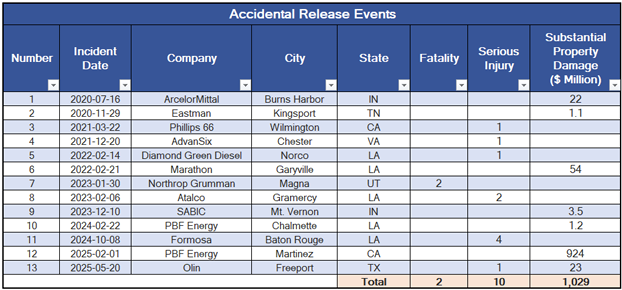
As of April 2026, the four volumes together cover 94 serious chemical incidents across 31 states, resulting in 16 fatalities, 75 serious injuries, and over $4.5 billion in property damage. The newest volume was provided in February, 2026. The incidents discussed in volume 4 are shown below.
Volume Summaries
- Volume 1 (January 2025) Covers 26 incidents from April 2020 to September 2023.
- Volume 2 (March 2025) Covers 25 incidents from May 2020 to August 2024 across 14 states.
- Volume 3 (July 2025) Covers 30 incidents across 15 states, with 2 fatalities and 25 serious injuries.
- Volume 4 (February 2026) Covers 13 major incidents across 7 states, including 2 fatalities and over $1 billion in damage. Highlights two high-consequence 2025 incidents involving mistaken equipment disassembly.
Why These Reports Matter
These volumes highlight recurring process safety issues and provide real-world examples for hazard recognition, common failure modes, and lessons learned. They are especially useful for training, PHA revalidation, and strengthening operational discipline.
- Guidelines for Investigating Process Safety Incidents, 3rd Edition
- Incidents That Define Process Safety
- More Incidents That Define Process Safety
- Missed opportunities: The consequences of ignoring risk recommendations
New CSB Video Highlights Ongoing Dangers of Combustible Dust (April, 2026)
The U.S. Chemical Safety and Hazard Investigation Board (CSB) has released a new safety video titled Deadly Dust – Explosions at Didion Milling. The video examines the 2017 corn dust explosions at the Didion Milling facility in Cambria, Wisconsin, which killed five workers and injured 14 others. Using animations and incident details, the video clearly shows how accumulated combustible dust led to both primary and secondary explosions — a common and deadly pattern in dust-related incidents.
The CSB determined the cause of the dust explosions and collapsed buildings in this incident was the ignition of combustible corn dust inside process equipment which transitioned to multiple explosions. Contributing to the severity of the explosions was Didion’s lack of engineering controls, which allowed the fire and explosions to propagate through the facility uncontrolled. The uncontrolled propagation of fire and explosions subsequently caused secondary explosions due to the inadequate fugitive dust management.
Other Related CSB Dust Videos
- Inferno: Dust Explosion at Imperial Sugar (2008 incident, updated video) — Documents the catastrophic sugar dust explosions in Port Wentworth, Georgia, that killed 14 workers and injured 38. This remains one of the most powerful illustrations of how secondary dust explosions can devastate a facility.
- Combustible Dust: An Insidious Hazard (2009) — A broader overview showing multiple dust incidents and why even small amounts of accumulated dust can create explosive conditions.
NFPA 660 – The New Consolidated Combustible Dust Standard
In response to these recurring tragedies, the National Fire Protection Association has released NFPA 660: Standard for Combustible Dusts and Particulate Solids. This new standard consolidates six previous dust-related standards (NFPA 61, NFPA 484, NFPA 652, NFPA 654, NFPA 655, and NFPA 664) into one comprehensive document. It provides updated requirements for hazard assessment, dust control, housekeeping, explosion protection, and fire prevention.
Why This Matters
Combustible dust incidents unfortunately continue to occur. Strong housekeeping, proper hazard evaluation, and consistent operational discipline are essential layers of protection. Many of the lessons from these events align directly with common audit findings and the need for rigorous adherence to procedures.
Have you reviewed your facility’s combustible dust housekeeping and hazard assessment programs recently? What challenges have you encountered with combustible dust control?
Recommended Resources
CSB-Reports
- Combustible Dust Hazard Investigation Page — Overview of CSB’s long-standing recommendations for a comprehensive OSHA standard.
- Deadly Dust – Explosions at Didion Milling — CSB Incident Report
- Inferno: Dust Explosion at Imperial Sugar — CSB Incident Report
NFPA & Standards
- NFPA 660: The New Standard on Combustible Dusts (GEAPS video/presentation) — Good practical explanation of what changed with the consolidation.
- “What Is a Combustible Dust Explosion?” (NFPA video) — Short, clear educational video.
Other Practical Resources
- Dust Safety Science — Excellent independent site with an incident database, podcast, research summaries, and practical guides. Very useful for real-world learning.
- OSHA Combustible Dust National Emphasis Program (NEP) — OSHA’s current inspection focus and guidance.
New CCPS Monograph on High Consequence, Low Probability Risk Scenarios (April 2026)
The Center for Chemical Process Safety (CCPS) recently published a new monograph addressing the technical and cultural challenges of managing High Consequence, Low Probability (HCLP) risk scenarios.
This guidance is particularly timely as organizations continue to grapple with how to effectively identify, assess, and mitigate rare but potentially catastrophic events within their process safety programs. The monograph explores both the analytical difficulties (e.g., limitations of traditional quantitative risk assessment for very low-probability events) and the organizational/cultural factors that often lead to under-appreciation of high-consequence risks.
Key themes include the need for robust hazard identification, careful application of inherently safer design principles, and fostering a culture that does not dismiss low-probability events simply because they have not occurred recently. It provides practical methods and examples for integrating HCLP considerations into existing PHA, LOPA, and risk management processes.
As someone who has performed many PHAs and reviewed numerous process safety programs, I find this monograph valuable because it reinforces that effective process safety requires both rigorous technical analysis and strong organizational discipline — especially when dealing with events that are statistically rare but devastating when they occur. Don’t be misled by very low probability events; while unlikely, unfortunately these types of events occur all too frequently. Risk evaluation is only the first part of risk management, with performance determined through day-to-day operational discipline in following well-designed process safety systems.
New CCPS STAA Monograph Provides Practical Guidance on Inherently Safer Design (April 2026)
The Center for Chemical Process Safety (CCPS) released a new monograph on Safer Technologies and Alternatives Analysis (STAA) in December, 2025. This guidance arrived at a particularly relevant time, as the EPA’s proposed “Common Sense Approach” rule seeks to revise mandatory STAA requirements that were introduced in the 2024 SCCAP rule.
With recent industry emphasis on inherently safety processes, and as a co-author of the 2026 CEP article Making ISD a Vibrant Part of Corporate Risk Management, it’s great to see the clear guidance provided by this monograph. It offers a clear, structured life-cycle framework for conducting effective STAA studies while emphasizing the hierarchy of controls and ISD principles: substitution, minimization, moderation, and simplification. Eliminating vs. managing process hazards through proper application of ISD is always preferred, when possible, especially early in R&D and project development stages where changes can be most cost effective.
Key strengths of the monograph include:
- Practical methods for identifying and evaluating safer alternatives during process design, PHA, and MOC activities
- Guidance on documenting STAA decisions in a way that is useful for both internal teams and regulators
- Realistic discussion of feasibility considerations — balancing safety benefits with technical, economic, and operational realities
Even if the final EPA rule reduces mandatory STAA requirements, as likely, companies that apply these principles appropriately will have more opportunities to reduce process hazard risks. Inherently safer thinking remains one of the most powerful tools we have for preventing major incidents, particularly as we work with more complex chemistries and new energy-related processes.
The monograph reinforces an important point made in the January CEP article: STAA should not be treated as a checkbox exercise with potentially impractical or unprioritized solutions. Focus on the highest risk and/or consequence opportunities for improvement. Apply the studies at appropriate life-cycle stages. Have the right expertise on the team. When done well, STAA becomes an integral part of a robust process safety program rather than an add-on.
EPA’s “Common Sense Approach” to RMP: Proposed Changes and Practical Implications (April 2026)
On February 24, 2026, the U.S. Environmental Protection Agency published a proposed rule titled “Accidental Release Prevention Requirements: Risk Management Programs under the Clean Air Act; Common Sense Approach to Chemical Accident Prevention.” The public comment period has been extended to May 11, 2026.
This proposal aims to revise or roll back several provisions from the 2024 Safer Communities by Chemical Accident Prevention (SCCAP) rule. The stated goals include reducing regulatory burden, avoiding duplication with OSHA PSM, and focusing requirements where they provide the greatest safety benefit.
Key areas addressed in the proposal include:
- Modifications to Safer Technology and Alternatives Analysis (STAA) requirements
- Adjustments to third-party audits, emergency response planning, information availability provisions, stationary source siting, natural hazards and power loss evaluation, and use of RAGAGEP
- Better alignment between RMP and OSHA PSM where appropriate, including employee participation, declined recommendation requirements, and retention of hot work permits
Facilities should carefully evaluate how these revisions might affect their current compliance programs, noting compliance timing, and consider submitting thoughtful comments by the May 11 deadline.
Tragic H₂S Release at Woodland Pulp Mill Highlights Critical Process Safety Lessons (April 2026)
On January 27, 2026, an apparent toxic hydrogen sulfide (H₂S) release occurred in the bleach plant area at Woodland Pulp Mill in Baileyville, Maine. The incident resulted in the deaths of two workers and injured nine others. Kasie Malcolm, a 20-year-old University of Maine chemical engineering student completing a co-op internship at the mill, died the following day. Allen Hornberger, 26, a process engineer who had joined the company in September 2025, died from his injuries on February 17.
According to initial information provided to the U.S. Chemical Safety Board (CSB), the release likely occurred when concentrated sulfuric acid mixed with sulfurous compounds in an enclosed process sewer, generating and releasing highly toxic H₂S gas, which has an IDLH of 300 ppm. The CSB opened a formal investigation on February 9, 2026, examining chemical handling practices, process safety systems, and emergency response actions. OSHA is also investigating.
Key Process Safety Lessons
It’s not clear whether this part of the mill is covered by OSHA PSM or EPA RMP or what process safety systems may have been implemented at the site. While all the facts of this incident are not known at this time and the incident investigation is being conducted, this incident may underscore several recurring themes in process safety, including:
- Hazard Recognition and Evaluation: The potential for unexpected chemical reactions in sewers or other site locations must be thoroughly evaluated, typically in a PHA. At this point, it’s not clear if this potential hazard had been identified and what PPE or other safeguards were provided.
- Chemical Incompatibility and Process Design: Even common chemicals like sulfuric acid can generate highly toxic gases when mixed with other materials present in the process, which should be documented in a chemical interaction matrix or other process safety information.
Incidents like this are rarely caused by a single failure. They often result from gaps in multiple layers of protection — exactly what PSM systems are designed to prevent. Other factors possibly involved include MOC, MOC-Personnel, and Emergency Planning & Response.
The CSB investigation will provide more details in the coming months. In the meantime, facilities handling toxic or reactive chemicals should consider reviewing the relevance of this incident for their hazardous processes.
Related Post: For a deeper discussion on chemical incompatibility hazards and a practical tool to help prevent them, see Chemical Incompatibility Hazards: Lessons from the Recent ChemE Student Fatality.
External News & Resources
Stay informed with the latest from leading process safety organizations. Here are reliable sources for ongoing news, reports, webinars, and publications:
- U.S. Chemical Safety and Hazard Investigation Board (CSB) – News releases, incident reports, safety videos, and investigations
- IChemE Safety Centre – Webinars, podcasts, safety lore, and process safety updates
- AIChE CEP Magazine – Regular process safety articles and news updates
- Journal of Petroleum Technology – Current process safety news
Previous Insights
- Future content
Have thoughts on a recent CSB incident, new CCPS tool, or regulatory proposal? Feel free to share perspectives in the comments or email jim@psmnews.com.