“Sustained great results depend upon building a culture of self-disciplined people who take disciplined action.” Collins, Good to Great, 2001
A Foundation for Excellent Process Safety Performance
Operational discipline (OD) describes human behavior in following required systems, every time, to consistently achieve organizational goals and overall operational excellence. While a focus on OD is not a panacea, OD is a fundamental part of effective programs for achieving excellent performance in process safety, safety, quality, reliability, and productivity. Well-designed management systems do not achieve these goals in isolation; the disciplined efforts of involved personnel in effectively implementing and following system requirements continuously are needed. The failure to follow a system requirement, even just once, due to human error, inattention, complacency, or some other reason, can result in significant consequences, such as personal injury, environmental harm, and business loss.
For example, an incident investigation by the U.S. Chemical Safety Board (CSB) concluded that an operator opened the bottom valve of an operating polymerization reactor, apparently bypassing an active pressure interlock, instead of the intended action of opening the bottom valve of a nearby reactor that was being cleaned (see the case study provided below). The resulting large release of hot, flammable material from the operating reactor ignited, leading to five fatalities and major damage to the facility. While human errors such as this example should be anticipated and appropriate safeguards should be provided to help prevent serious injuries and other significant consequences, a focus on OD – doing the right thing, every time – is an essential component of effective safety programs and the ability to achieve excellent safety performance.
Characteristics of Effective OD Programs
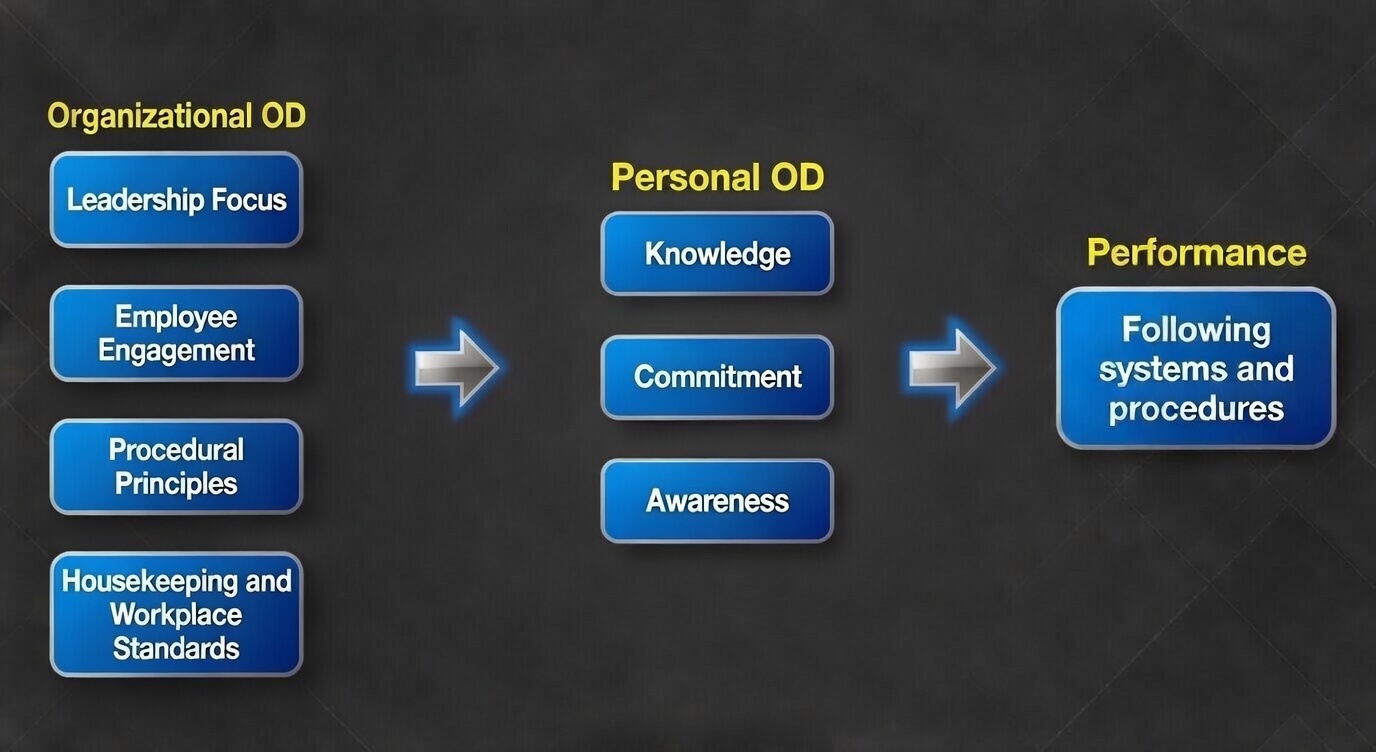
Effective OD programs include a focus on both Organizational OD and Personal OD. Organizational OD is intended to help company and/or facility leadership develop effective OD programs based on:
- Leadership Focus – Leaders emphasize and provide a positive work environment, managing processes and resources for effective programs and employee engagement. Leaders are personally involved and passionate for safety and model the behaviors they expect from their organization.
- Employee Engagement – Employees understand and value the importance of safe work activities and contribute to organizational programs and activities.
- Procedural Principles – Correct ways of doing work are defined and completed as planned, following documented and authorized systems and procedures.
- Housekeeping and Workplace Standards – Standards are established for maintaining safe equipment, tools, and facilities. Employees are proud of their work environment and consistently maintain high levels of housekeeping.
The foundation of any organizational effort is Leadership Focus, without which priority and support for the program cannot exist. Organizational OD also requires strong Employee Engagement, where high levels of uninterested and uninvolved employees will limit the organization’s ability to achieve strong process safety performance. The most visible results of Leadership Focus and Employee Engagement are employees following approved procedures that they’ve been trained on (Procedural Principles) and maintaining equipment and work areas in good operating condition (Housekeeping and Workplace Standards). Organizational OD efforts are closely related to good safety culture and leadership practices.
Personal OD is intended to help support the day-to-day focus of employees in doing their work correctly and safely every time:
- Knowledge – Know how to do their work tasks correctly and safely.
- Commitment – Commit and plan to do them the correct way without deviations or shortcuts, based on training.
- Awareness – Anticipate and are prepared for what could go wrong or look for and recognize what may be different in their current work environment and respond accordingly, based on training and experience.
The goal is to have knowledgeable, prepared, experienced workers at all levels of the organization who account for the existing work environment rather than have an unquestioning focus on strict adherence to procedure when circumstances are different or changing. This requires developing appropriate operating procedures and effective on-the-job training for required work activities, which also include recognition and troubleshooting of possible deviations and the correct ways to respond to them.
Benefits of an Effective OD Program
Some of the benefits of an effective OD program include:
- Process (and other) hazards and risks are identified, evaluated, and managed
- Equipment and facilities are properly designed, operated, and maintained
- Management systems are well designed, implemented, executed, and supported
- Operating problems and incidents are consistently investigated and corrected.
Effective OD programs reduce the risk of things going wrong, possibly leading to operating problems, serious injuries and hazardous events. As a result, process safety and SHE performance, productivity and cost, and product quality performance should improve.

“Well-designed SHE systems are only as effective as the day-to-day ability of everyone in an organization to rigorously follow procedures correctly and safely every time. Once effective SHE systems have been developed, therefore, the greatest opportunity for maintaining and improving SHE performance may result from emphasizing, evaluating, and improving OD.” Klein/Vaughen, A Revised Program for Operational Discipline, 2008
Implementing or Improving an OD Program
Getting started in implementing an effective OD program or improving an existing program, of course, depends on your starting point and intended goals. Key activities include:
- Focus on OD improvement
- Raise awareness and value for OD
- Evaluate OD performance
- Identify, prioritize, and pursue improvement opportunities
- Sustain and renew OD program activities.
These steps are discussed in the following full paper which was published in two parts in Hydrocarbon Processing (see references):
Resources
References
Process Safety: Key Concepts and Practical Approaches, 2017
Conduct of Operations and Operational Discipline, 2011 (disclosure: I was project leader)
- Factors That Impact Safety Performance and How They Can Be Used to Achieve and Sustain Excellent Performance, Professional Safety, 2021
- Implement Effective Operational Discipline Programs to Improve Process Safety Performance – Parts 1 and 2, Hydrocarbon Processing, 2021
- Sustaining Effective Process Safety Programs in CPI Facilities, Chemical Engineering, 2020
- Turn Up Process Safety Performance: Implementing an Effective Operational Discipline Program Can Help, Chemical Processing, 2019
- Our Process Safety Journey Continues: Operational Discipline Today, Process Safety Progress, 2018 (with Bruce K. Vaughen [main author] and John C. Champion)
- Improving the Performance of Established PSM Programs, Process Safety Progress, 2012 (with S. Dharmavaram)
- Focus on Personal Operational Discipline to Get Work Done Right, Process Safety Progress, 2012 (with Eduardo M. Francisco)
- Improving Operational Discipline to Help Prevent Loss of Containment Incidents, Process Safety Progress, 2011 (with Bruce K. Vaughen)
- Implement an Operational Discipline Program to Improve Plant Process Safety, CEP, 2011 (with Bruce K. Vaughen)
- Implementing an Effective Conduct of Operations and Operational Discipline Program, J. Loss Prevention, 2011 (with William M. Bradshaw, Lee N. Vanden Heuvel, Donald K. Lorenzo, and Gregory Keeports)
-
A Revised Model for Operational Discipline, Process Safety Progress, 2008 (with Bruce K. Vaughen)
-
Operational Discipline in the Workplace, Process Safety Progress, 2005