The primary objectives of effective process safety programs are identifying, evaluating, and managing process hazards to help achieve excellent performance and ensure safe processes and facilities.
Building a strong process safety program is challenging, but sustaining high performance over the long term is even harder. Many organizations see initial improvements after implementing process safety systems, only to experience performance drift or decline years later.
In my 2020 article Sustaining Effective Process Safety Programs in CPI Facilities in Chemical Engineering, I outlined a practical framework for sustaining effective process safety programs in CPI facilities. This post expands on that framework and incorporates insights from related papers on factors affecting safety performance and the critical role of operational discipline. The full paper can be downloaded below.
Why Focus on Performance?
First, compliance with regulations may not be sufficient to achieve excellent performance. Regulations don’t necessarily include all factors that may be important, such as safety culture and operational discipline (OD).
Second, since many regulations use threshold quantities (TQ) of listed chemicals, not all process hazards may be covered by regulation. Significant hazards may be present even below the TQs and other types of chemicals or process hazards (e.g., chemical reactivity) may not be covered by the regulation.
A focus on performance helps ensure that all process hazards are identified and managed through appropriate risk management practices, effective process safety programs, and continuous improvement goals. Questions to consider for process safety performance were discussed in two CEP safety columns:
A CEP safety column on factors that can rob the pillars of performance is also available.
A Systems Framework for Process Safety Performance
Effective and sustained process safety performance requires more than just implementing the 14 PSM elements or 20 RBPS elements. It depends on understanding the key factors that influence performance and creating an integrated system that continuously monitors, learns, and improves, based on rigorous identification and management of process hazards.
A simple but powerful model showing the major categories that drive process safety performance is provided (see below) and explained in the paper.
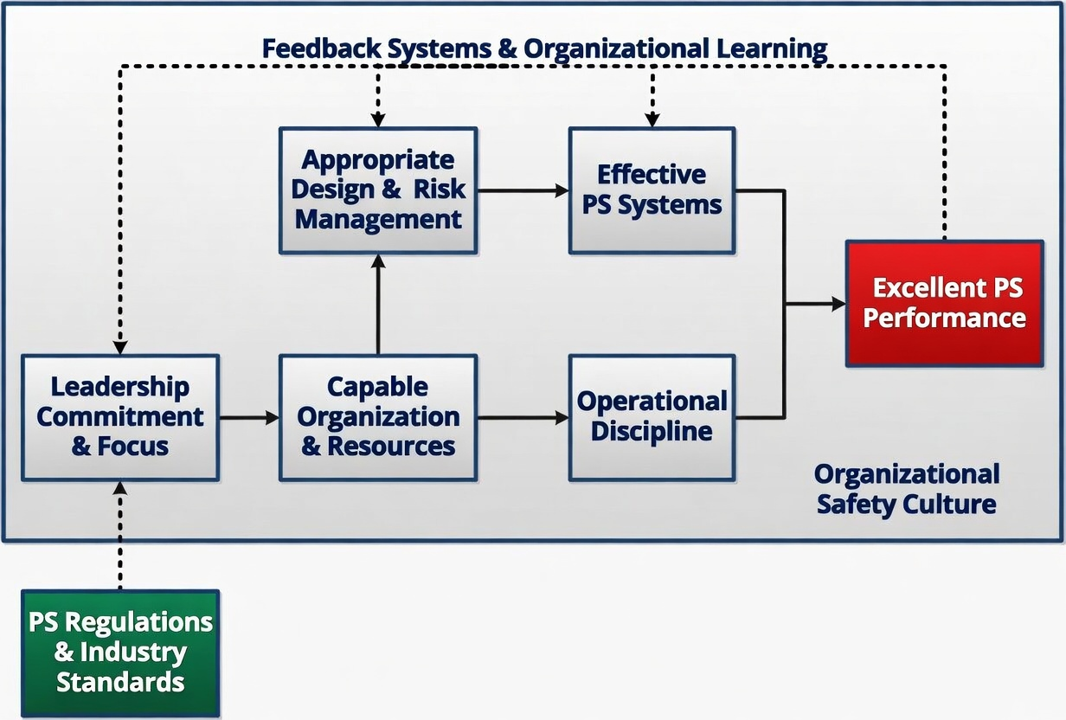
Current Performance and Trends
While assessing current performance seems straightforward, serious process safety incidents are (hopefully) rare, and therefore performance is typically assessed in terms of conformance to process safety system requirements. Both internal and external measurements should be considered when evaluating process safety performance, based on appropriate metrics and feedback systems. Facilities must, at a minimum, be aware of industry standards and best practices for comparison and should benchmark operating results with other facilities and companies whenever possible.
The current status is important because if a company already has excellent performance, it should mainly desire to sustain that high level with appropriate monitoring and continuous improvement goals. If a company has poor performance, it should set goals and provide resources for improvement. The trend is also important: is performance getting better, getting worse, or staying about the same. Several pathways are possible, as explained in the paper. Typically, if appropriate systems and improvement goals are not established, performance might be expected to drift downward as shown by the entropic line in the figure.

Practical Steps to Sustain High Performance
Several suggestions on improving process safety performance are provided in the references below, including:
- Ensure all process hazards have been identified and review current risk management practices to determine if process risks are being properly evaluated. If process hazards are not properly identified and evaluated, appropriate process safety programs cannot be developed to manage these hazards.
- Manage process safety programs based on the process hazards that are present, in addition to compliance with related regulatory requirements. Regulatory requirements should be considered minimum essential practices, and additional requirements should be implemented based on risk management evaluations, as needed.
- Set process safety improvement goals annually and provide appropriate feedback systems using both leading and lagging metrics to measure progress and provide early warning of performance issues. Ensure timely follow-up on specific issues identified from these feedback systems.
- Provide strategies to maintain a sense of vulnerability in personnel at all levels. Lack of a sense of vulnerability can cause complacency, especially when performance has been strong for a long time, leading to a mistaken belief that good performance is routine and expected, rather than requiring continued focus and diligence.
- Implement an effective mechanical integrity program to maintain aging equipment and help prevent loss-of-containment incidents. The program should include appropriate focus on maintenance procedures and training, equipment inspection and testing, and quality assurance.
- Identify opportunities to improve operational discipline (OD). Process safety systems only work as intended if personnel are actually following them, and even highly trained and dedicated people occasionally make mistakes. Human error should be anticipated and appropriate safeguards should be provided to make sure errors do not lead to serious injuries and incidents.
Are You Sustaining High Process Safety Performance?
Take a moment to assess your own facility or organization:
- Do you have clear leading indicators that provide early warning of performance issues?
- Is operational discipline consistently strong across all shifts and departments?
- Does leadership regularly review process safety metrics and act on what they reveal?
Sustaining excellent process safety performance requires ongoing effort, but the payoff — fewer incidents, greater reliability, and protected lives — is well worth it.
Download Chemical Engineering original paper PDF
References & Recommended Reading
-
- Process Safety: Key Concepts and Practical Approaches
- Sustaining Effective Process Safety Programs in CPI Facilities, Chemical Engineering, 2020
- Factors That Impact Safety Performance and How They Can Be Used to Achieve and Sustain Excellent Performance, Professional Safety, 2021
- Turn Up Process Safety Performance: Implementing an Effective Operational Discipline Program Can Help, Chemical Processing, 2019
- Audit Process Safety for Compliance and Performance, CEP, 2022 (with James Thompson)
- Sustaining Effective Process Safety Programs, Purdue Process Safety Conference, 2021
What challenges have you faced in sustaining process safety performance over time? Share your experiences in the comments or contact me at jim@psmnews.com.