Chemical Incompatibility Hazards: Lessons from the Recent ChemE Student Fatality
In the January 27, 2026 a toxic gas release at the Woodland Pulp mill in Baileyville, Maine, 20-year-old chemical engineering student Kasie Malcolm tragically died while working as an intern. A second worker later died from injuries sustained in the same event. The release possibly occurred when concentrated sulfuric acid mixed with sulfurous compounds in a process sewer, generating toxic hydrogen sulfide gas, according to a preliminary CSB investigation and news release.
This incident highlights a critical but sometimes under-appreciated aspect of process safety: chemical incompatibility and reactivity hazards. Even when individual chemicals are familiar, unexpected interactions can create dangerous conditions if proper hazard identification is not performed. Effective process safety programs carefully evaluate possible incompatibilities and both intended and unintended reactions that may be possible. The OSHA PSM standard, if applicable to the facility, requires that the “hazardous effects of inadvertent mixing of different materials that could foreseeably occur” be evaluated as part of the process safety information.
The AIChE Chemical Reactivity Worksheet (CRW)
One of the most practical tools available to identify and prevent such hazards is the free AIChE Chemical Reactivity Worksheet (CRW), developed by the Center for Chemical Process Safety (CCPS) in cooperation with NOAA and others. The CRW has also been added as part of the CAMEO chemicals software available free from EPA.
The CRW allows users to quickly evaluate the reactivity and incompatibility of thousands of common chemicals. It helps answer key questions such as:
- Are chemical self-reactive?
- What hazardous byproducts could form if these chemicals mix?
- Are there incompatible materials of construction or absorbent
A chemical compatibility interaction matrix should be developed for all the substances and materials that have been identified as part of a chemical process, as well as possible substances that may inadvertently be present, to identify potential reactions: intended, unintended but possible, or resulting from inadvertent mixing of materials. The CRW is a convenient and free tool that easily supports developing interaction matrices and provides underlying documentation to allow analysis of reaction predictions. The CRW includes:
- pure component intrinsic hazards, flammability, and reactivity for thousands of substances
- a worksheet to predict specific binary interactions for up to 100 component mixtures with supporting documentation that provides for additional research
- the ability to use functional groups for predictions and to add additional substances to the database.
Results should normally be reviewed by a chemist or other knowledgeable resource, modelled, or investigated experimentally, as appropriate. CRW predictions do not account for ternary and greater interactions, so additional evaluation will be needed for more complex mixtures.
Example Application of the CRW
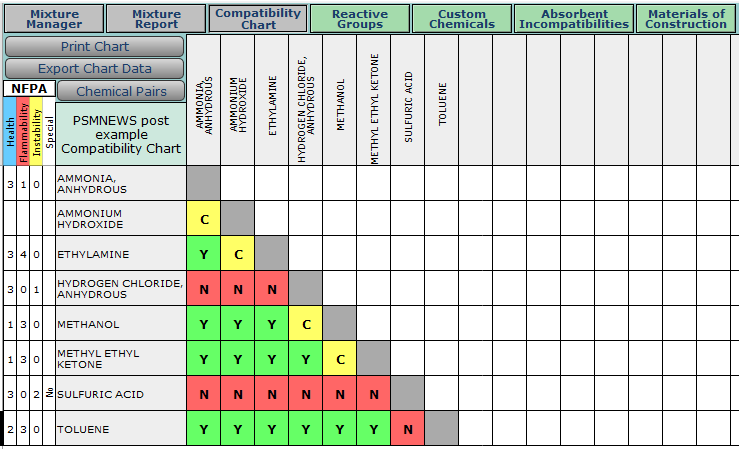
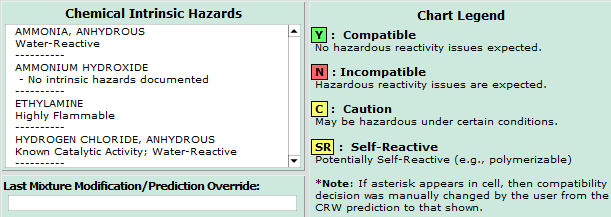
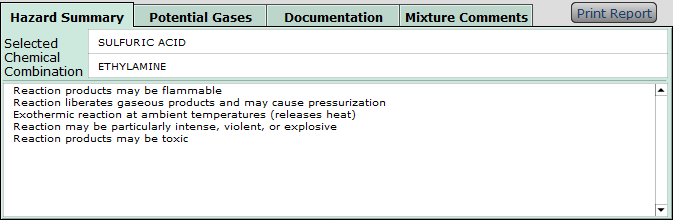
The interaction matrix shown below contains several chemicals where the connecting column and row cells provide information whether a reaction can occur (Y, N, C, SR as shown in the legend in the second figure). Clicking on the cell provides more information on the types of reactions that may be possible as shown in the third figure. Tabs are available above the interaction matrix to provide information on absorbent incompatibilities and materials of construction.
Cole-Parmer Chemical Compatibility Database
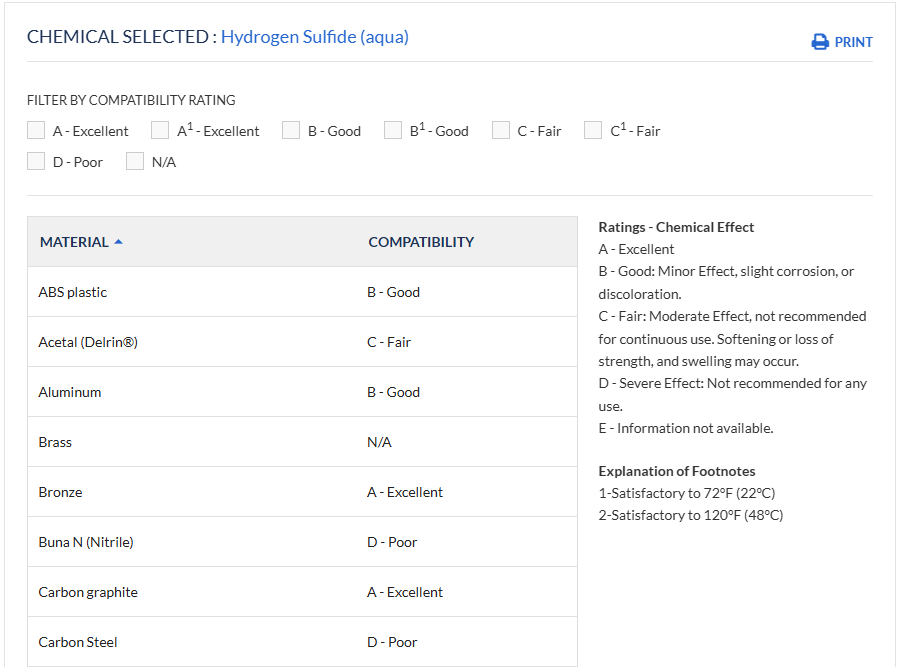
The Cole-Parmer website provides an online Chemical Compatibility Database (CCD) that provides data on both chemical/material compatibility and chemical/chemical miscibility (limited data). An example is shown below for hydrogen sulfide with several different materials. Materials can be selected individually or with all materials available as partly shown. The database tables or at least links to the database can be included in a site’s process safety information documentation to help with initial selection of suitable materials as well as evaluating process changes as they are made.
Practical Recommendations
Chemical incompatibility hazards must be evaluated, whether required by process safety regulations or not and should be part of the process safety documentation for the process. I’ve written several process safety audit findings related to chemical reactivity and incompatibilities over the years. In particular, ensure that chemical reactivity interaction matrices and other supporting information are maintained current through effective management of change procedures. New chemicals or materials mean new interactions that should be appropriately evaluated. It may also be possible to remove chemicals no longer in use.
These tools are available free of charge, and I strongly encourage industrial engineers and chemists, researchers, students, and others working with chemicals to become familiar with them.
Like all tools, results from both the CRW and the Cole-Parmer CCD should be carefully reviewed by qualified chemists or other experts to help ensure that the data provided is reasonable and accurate.
Download the AIChE Chemical Reactivity Worksheet: AIChE CRW Download
Final Thoughts
This tragic incident reminds us that even well-intentioned work in familiar environments can carry hidden risks when chemical incompatibilities are not fully evaluated. Tools like the CRW provide a simple yet powerful way to uncover those risks before they lead to harm.
What experiences have you had with chemical reactivity or incompatibility hazards? Have you used the CRW or similar tools? Share your thoughts in the comments or contact me at jim@psmnews.com.
References
- Klein and Vaughen, Process Safety: Key Concepts and Practical Approaches, 2017
- CCPS, Guidelines for Chemical Reactivity Evaluation and Application to Process Design, 1995 (2nd Edition, Aug. 2026)
- CCPS, Essential Practices for Managing Chemical Reactivity Hazards (A CCPS Concept Book), 2022